
Deep Learning - 45 Days Internship Training Program
Join 45 Days Deep Learning Internship Training Program at NextVision Infotech. Learn neural networks, CNN, RNN, LSTM, transformers, TensorFlow. ₹649 only with certificate.
Program Description
Skills You'll Learn
Projects You'll Work On
Complete Deep Learning Project
Students will complete a full deep learning project including data collection, preprocessing, neural network design, model training, hyperparameter tuning, model evaluation, deployment, and complete project documentation as per industry standards.
Program Modules
W1: Week 1: Deep Learning Fundamentals and Neural Networks
Introduction to deep learning, deep learning vs machine learning, biological neurons, artificial neurons, perceptron, multilayer perceptron (MLP), activation functions - sigmoid, tanh, ReLU, Leaky ReLU, ELU, Swish, softmax, forward propagation, loss functions - MSE, MAE, cross-entropy, binary cross-entropy, categorical cross-entropy, backpropagation, gradient descent, learning rate, epochs, batches, batch size, iterations, weight initialization - Xavier, He, vanishing gradient, exploding gradient, TensorFlow, Keras, PyTorch, deep learning frameworks comparison, GPU computing, CUDA, Google Colab.
W2: Week 2: Training Neural Networks and Optimization
Training neural networks, optimization algorithms - SGD, momentum, Nesterov momentum, AdaGrad, RMSProp, Adam, AdamW, learning rate scheduling, learning rate decay, step decay, exponential decay, cosine annealing, warm restarts, regularization techniques - L1, L2, dropout, batch normalization, layer normalization, early stopping, data augmentation, transfer learning basics, hyperparameter tuning - learning rate, batch size, number of layers, number of neurons, activation functions, optimizers, model evaluation, confusion matrix, precision, recall, F1-score, ROC-AUC, model saving and loading.
W3: Week 3: Convolutional Neural Networks (CNNs)
Introduction to computer vision, image representation, convolution operation, filters, kernels, padding, stride, pooling - max pooling, average pooling, global average pooling, CNN architecture, convolutional layer, pooling layer, fully connected layer, feature maps, receptive field, CNN architectures - LeNet, AlexNet, VGG, GoogLeNet, ResNet, DenseNet, MobileNet, EfficientNet, Inception, transfer learning, fine-tuning, pre-trained models, image classification, object detection - R-CNN, Fast R-CNN, Faster R-CNN, YOLO, SSD, semantic segmentation - U-Net, Mask R-CNN, data augmentation for images.
W4: Week 4: Recurrent Neural Networks (RNNs) and Sequence Models
Introduction to sequence data, RNN fundamentals, RNN architecture, hidden state, backpropagation through time (BPTT), vanishing gradient problem, exploding gradient problem, LSTM (Long Short-Term Memory), LSTM architecture, forget gate, input gate, output gate, cell state, GRU (Gated Recurrent Unit), GRU vs LSTM, bidirectional RNN, deep RNN, sequence-to-sequence models, encoder-decoder architecture, attention mechanism, self-attention, transformer architecture, BERT, GPT, text preprocessing, tokenization, word embeddings - Word2Vec, GloVe, FastText, sentiment analysis, text classification, named entity recognition, machine translation, text generation.
W5: Week 5: Advanced Architectures, Transfer Learning, and Live Projects
Generative adversarial networks (GANs), GAN architecture, generator, discriminator, GAN training, DCGAN, WGAN, StyleGAN, CycleGAN, Pix2Pix, autoencoders, variational autoencoders (VAEs), denoising autoencoders, sparse autoencoders, attention mechanisms, transformers, Vision Transformers (ViT), transfer learning, fine-tuning, feature extraction, domain adaptation, few-shot learning, zero-shot learning, meta-learning, reinforcement learning basics, live projects - image classification, object detection, sentiment analysis, time series forecasting, recommendation system, complete documentation.
W6: Week 6: Deployment, Documentation, Viva, and Certification
Model deployment, model optimization - quantization, pruning, knowledge distillation, TensorFlow Lite, TensorFlow.js, ONNX, model serving, Flask API, FastAPI, Streamlit, Gradio, cloud deployment - AWS, GCP, Azure, Docker, MLOps for deep learning, model monitoring, version control with Git and GitHub, project documentation, resume building, interview preparation, viva-voce examination, feedback session, certificate distribution.
Key Features
What You'll Learn
Examination Details
| Exam Name | Full Marks | Pass Marks |
|---|---|---|
| Module-wise Assessment | 100 | 40 |
| Project Evaluation | 100 | 50 |
| Final Presentation | 50 | 25 |
| Viva-Voce | 50 | 25 |
Internship Details
Prerequisites
- Pursuing or completed B.Tech/B.E./BCA/MCA/B.Sc. in Computer Science, IT, or related field
- Basic knowledge of Python programming
- Basic knowledge of machine learning concepts
- Basic mathematics and linear algebra knowledge
- Interest in deep learning
Who Can Enroll ?
- B.Tech Computer Science students (1st to 8th semester)
- B.E. IT students
- BCA students (1st to 6th semester)
- MCA students
- B.Sc. Computer Science students
- Deep learning aspirants
- Working professionals wanting to upskill
- Students from all over India seeking practical training
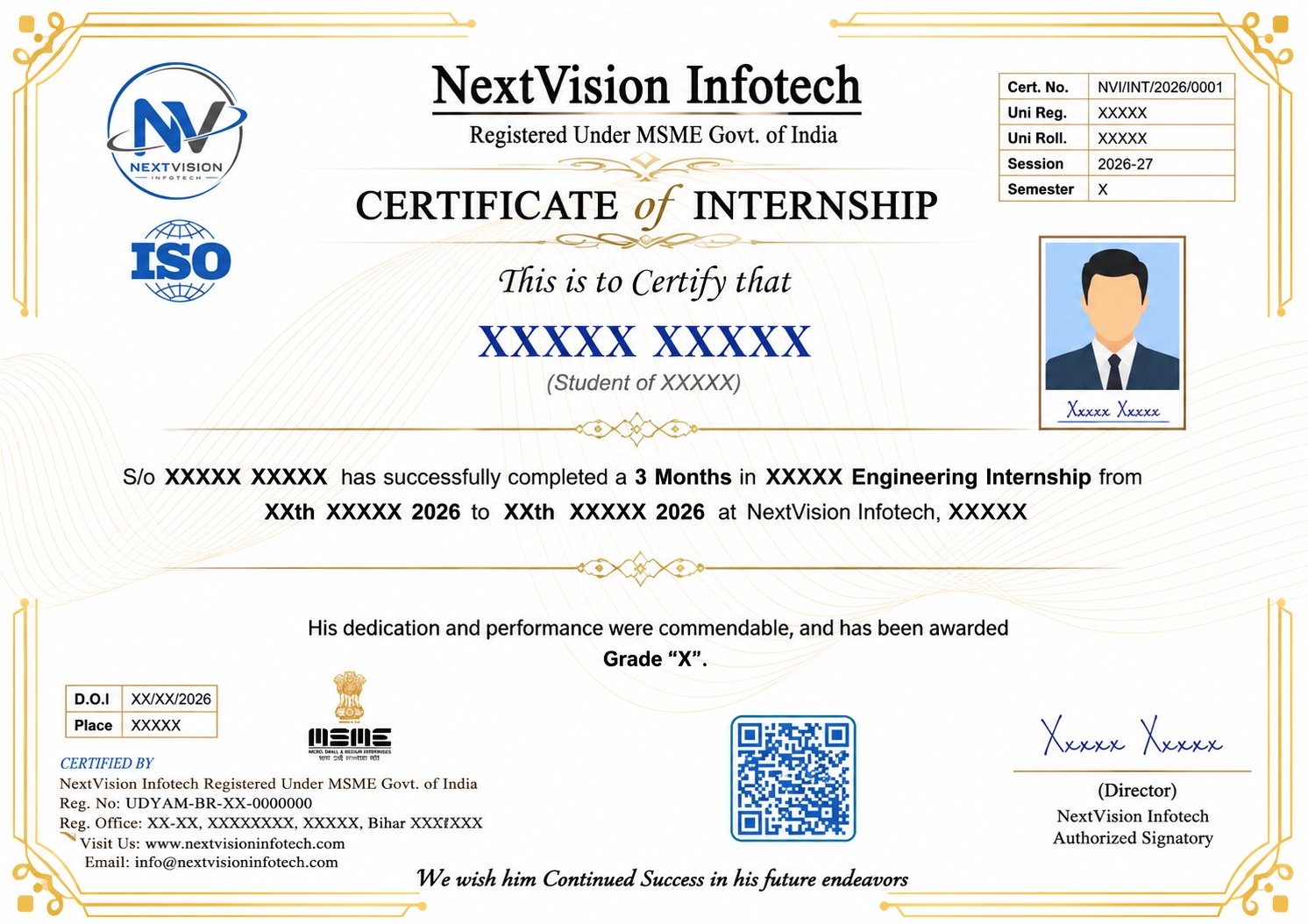
Certificate Preview
Related Internships
You might also be interested in these
Machine Learning with Python - 45 Days Internship Training Program
Join 45 Days Machine Learning with Python Internship Tr...
Generative AI - 45 Days Internship Training Program
Join 45 Days Generative AI Internship Training Program...
Data Analytics with Power BI - 45 Days Internship Training Program
Join 45 Days Data Analytics with Power BI Internship Tr...
AI & Machine Learning - 15 Days Internship Training Program
Join 15 Days AI & Machine Learning Internship Training...
Our Students Did It! 🎉 Certified & Proud
A big congratulations to our students who recently completed their courses and earned their certificates. Here's what they have to say! 🎓

MURUGESH A B
Internship Program
"Best decision I ever made! The teaching quality and practical training helped me land my dream job. Highly recommended! 🌟"
Simran Shree
Internship Program
"Amazing experience! The mentors are super supportive and the course content is industry-ready. Got my certificate with confidence! 💯"
SUNNY KUMAR
Internship Program
"NVI Gaya changed my career path completely. Practical projects, real-world skills, and expert guidance — everything was perfect! 🚀"

Santu Kumar
Course Program
"Learned so much in such a short time. The internship gave me real experience and confidence to face interviews. Thank you NVI! 🙏"
Shibolin Rabeena L
Internship Program
"From zero to hero — that's how I feel after completing this course. The staff is friendly and always ready to help! ⭐"
Samiksha Suresh Patil
Internship Program
"Excellent learning environment with hands-on training. I got placed right after completing my course. Forever grateful! 🎓"
Divyanshu Raj
Internship Program
"The best institute in Gaya for computer courses. Practical knowledge, live projects, and job-ready skills — worth every rupee! 💎"

SHIVAM YADAV
Course Program
"Small batch sizes meant personal attention. My mentor guided me at every step. Truly a life-changing experience! ✨"

Sayan Kundu
Internship Program
"Best decision I ever made! The teaching quality and practical training helped me land my dream job. Highly recommended! 🌟"
Shashikant Shukla
Internship Program
"Amazing experience! The mentors are super supportive and the course content is industry-ready. Got my certificate with confidence! 💯"

Abhay Kumar
Internship Program
"NVI Gaya changed my career path completely. Practical projects, real-world skills, and expert guidance — everything was perfect! 🚀"

Prince raj
Internship Program
"Learned so much in such a short time. The internship gave me real experience and confidence to face interviews. Thank you NVI! 🙏"

Rishita chauhan
Internship Program
"From zero to hero — that's how I feel after completing this course. The staff is friendly and always ready to help! ⭐"
Neha D
Internship Program
"Excellent learning environment with hands-on training. I got placed right after completing my course. Forever grateful! 🎓"

Prem vardhan
Internship Program
"The best institute in Gaya for computer courses. Practical knowledge, live projects, and job-ready skills — worth every rupee! 💎"
Our Certificate Samples
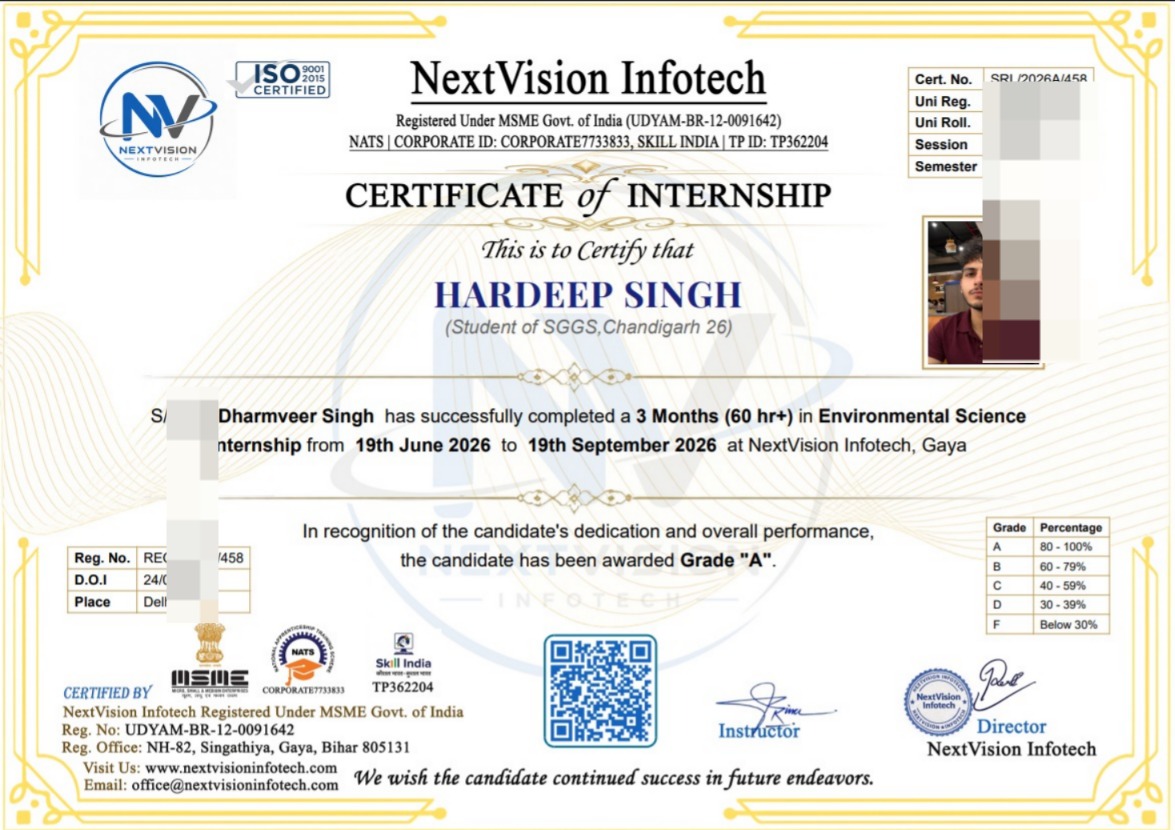
Internship Certificate
Tap to view
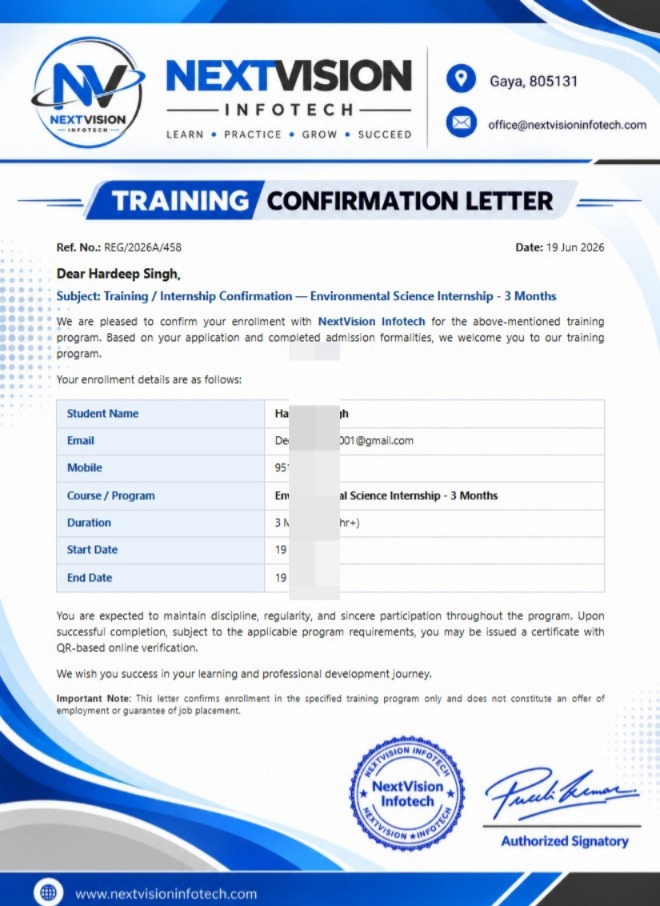
Joining Letter
Tap to view
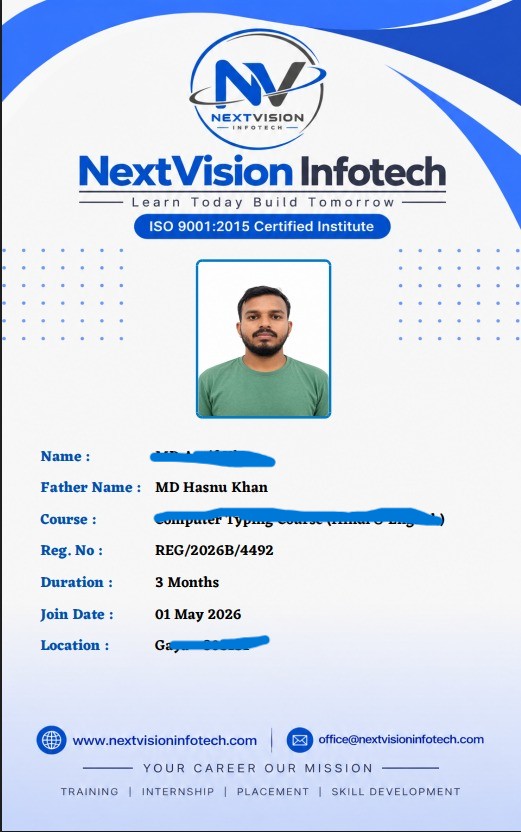
Student ID Card
Tap to view
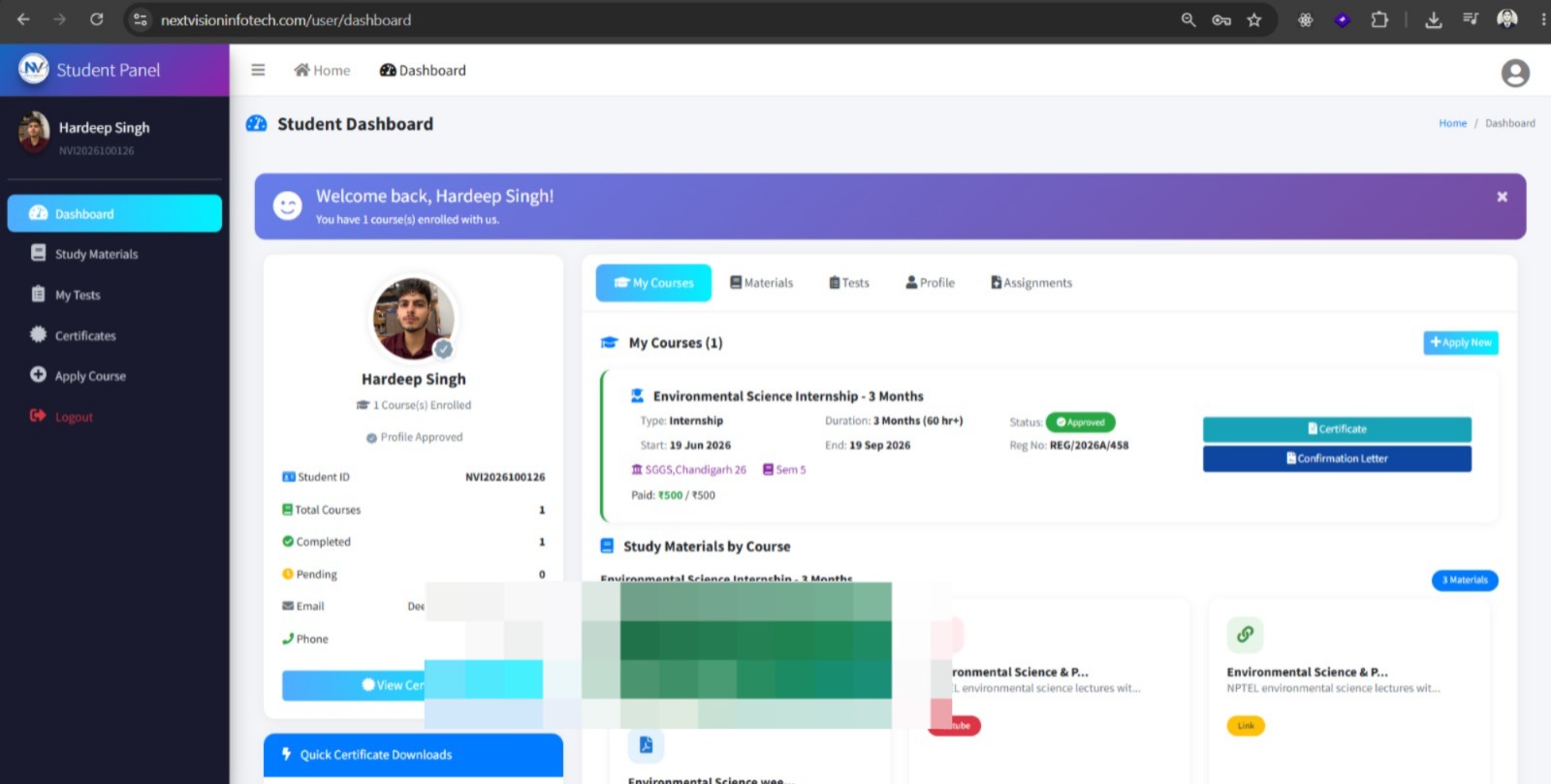
Student Panel
Tap to view
All certificates are issued by NextVision Infotech & are verifiable upon request.
Ready to Start Your Journey?
Take the first step towards your dream career with our internship programs